
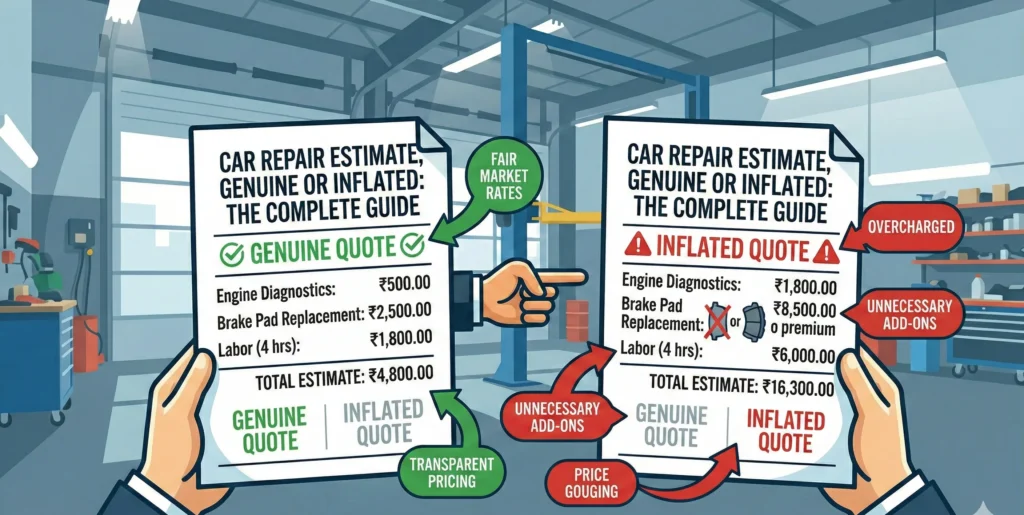

The Problem Every Car Owner Faces
You drop your car at the service center for what seems like a simple issue. Two hours later, you get a call: “Sir, we found multiple problems. Total estimate car repair quote is ₹45,000.”
Your stomach drops. You don’t understand half of what they’re saying. You can’t verify if the repairs are necessary. And you’re terrified of saying no—what if your car breaks down on the highway?
So you agree. You pay. And you leave feeling like you’ve been robbed, but with no way to prove it.
This scenario plays out thousands of times daily across India. The result? Indian car owners overpay an average of ₹8,500 annually on unnecessary or inflated repairs, according to the Automotive Component Manufacturers Association (ACMA) 2024 report. Over a typical 10-year car ownership period, that’s ₹85,000-₹1.5 lakhs in wasted money.
The worst part? 67% of car owners believe they’ve been overcharged at least once, but only 12% actually challenged the quote (Consumer Trust in Automotive Services Study, 2024).
This guide changes that. You’ll learn exactly how to identify inflated quotes, what questions to ask, and how to protect yourself—even if you know nothing about cars.
Understanding the Quote Inflation Problem: The Numbers
The Scale of the Issue
India’s Automotive Service Market (2025 Data):
- Total market size: ₹1.2 trillion
- Vehicles serviced annually: 45 million+
- Average repair visits per vehicle: 3.2 times/year
- Estimated annual overcharging: ₹38,250 crores across all customers
Customer Experience Statistics:
- 68% report confusion during service interactions
- 41% have switched service providers due to trust issues
- 34% of recommended services are declined due to lack of understanding
- 89% wish mechanics would explain things more clearly
- Only 23% “completely trust” their mechanic
The Financial Impact:
| Cost Category | Annual Amount Per Car | 10-Year Total |
| Unnecessary services paid for | ₹8,510 | ₹85,100 |
| Delayed necessary repairs (inflated later) | ₹12,400 | ₹124,000 |
| Emergency repairs from delayed maintenance | ₹3,200 | ₹32,000 |
| Lost vehicle value (poor maintenance records) | – | ₹65,000 |
| Total Average Loss | ₹24,110 | ₹306,100 |
Sources: ACMA Industry Report 2024, SIAM Aftermarket Study 2024, Consumer Trust Survey 2024
Why Quote Inflation Happens
Understanding the root causes helps you spot and prevent inflated quotes:
1. Incentive Misalignment
- Service advisors earn 8-12% commission on services sold
- Mechanics paid per job completed (faster = more income)
- Service centers optimize for transaction revenue, not customer lifetime value
Result: Systemic pressure to oversell and overcharge
2. Information Asymmetry
- Customer has zero technical knowledge
- Mechanic has complete information
- No easy way to verify claims
- Customer fears consequences of declining
Result: Exploitation of knowledge gap
3. Lack of Transparency
- Verbal quotes without itemization
- Technical jargon that confuses
- Hidden fees in final bill
- No visual proof of issues
Result: Customer can’t evaluate fairness
4. Time Pressure
- Car already disassembled
- Customer needs car urgently
- “Repair now or engine will fail”
- No time to get second opinion
Result: Forced acceptance of inflated quotes
Part 1: Understanding the Problem First (Before the Quote)
The Communication Red Flags
A genuine mechanic will explain the issue clearly. An inflating mechanic will keep you confused. Here’s how to tell the difference:
Genuine Mechanic Communication:
Explains in plain language: “Your brake pads are worn down to 2mm thickness. The minimum safe thickness is 3mm. Below that, the metal backing plate damages your rotor, turning a ₹4,000 repair into a ₹15,000 repair.”
Shows you the problem: Takes you to the car, shows worn brake pads, lets you see/feel the issue
Explains consequences clearly: “If you drive another 2,000 km, you’ll need rotors replaced too. If you fix it now, just pads. Your choice.”
Welcomes questions: “Do you want me to explain how brake pads work?” or “Any questions before we start?”
Provides options: “You can use OEM pads for ₹5,500 or quality aftermarket for ₹3,800. Both are safe. OEM lasts 20% longer typically.”
Inflating Mechanic Communication:
Uses confusing jargon: “Your brake caliper assembly has seized due to pad substrate separation causing hydraulic fluid contamination requiring complete system flush and component replacement.”
Refuses to show issues: “It’s deep inside, very technical, you wouldn’t understand even if I showed you”
Vague consequences: “Everything is urgent. All must be fixed now or car is dangerous.”
Discourages questions: Gets annoyed, defensive, or dismissive when questioned
Only one option: “This is what needs to be done. No other choice.”
The Three Questions Test
Before accepting ANY repair quote, ask these three questions. An honest mechanic will answer clearly. A dishonest one will dodge or deflect.
Question 1: “Can you show me the problem?”
Honest mechanic response:
- Takes you to car immediately
- Points out specific issue
- Shows comparison (worn vs. new part)
- Takes photos for your records
Dishonest mechanic response:
- “It’s too technical”
- “You wouldn’t understand”
- “Trust me, I’m the expert”
- Changes subject or gets defensive
Question 2: “What happens if I delay this repair by 2-4 weeks?”
Honest mechanic response:
- Clear consequence explanation
- Distinguishes critical vs. can-wait
- “Critical issues: brake failure, steering issues, smoke—fix immediately”
- “Can wait: minor oil leak, worn wipers, cosmetic issues”
Dishonest mechanic response:
- Everything is “urgent”
- Vague disaster predictions
- Pressure tactics
- “Engine will seize any moment”
Question 3: “Can I get a detailed written estimate before you start work?”
Honest mechanic response:
- “Absolutely, let me write it down”
- Itemized: parts + labor + taxes
- Signed estimate with validity period
- “If we find additional issues, we’ll call you first”
Dishonest mechanic response:
- “We’ll calculate after”
- Verbal quote only
- Starts work without approval
- “Estimate keeps changing”
Case Study: How Clear Communication Saved ₹33,500
Rajesh’s Experience – Mumbai, September 2025
Initial Situation: Rajesh, 38, IT professional, took his 2019 Hyundai Creta for “suspension noise” at a local garage he’d never used before.
First Quote (Inflated):
Mechanic: “Your suspension is completely damaged. Need complete overhaul. All shock absorbers, control arms, bushings, ball joints—everything must be replaced.”
Total quote: ₹42,000
Red flags Rajesh noticed:
- No explanation of WHAT was damaged specifically
- Refused to show him the parts
- Pressured immediate decision (“Car is not safe to drive”)
- Verbal quote, no breakdown
Rajesh’s Action: Took car to another workshop for second opinion (another car repair quote).
Second Quote (Genuine):
Mechanic: “Let me show you the issue. See here—these rubber bushings in your suspension arms are worn out. The metal arms themselves are fine. Just the rubber parts need replacing. The shock absorbers are still good—I tested the bounce. Here, feel this—the car settles in 2 bounces, which is normal.”
Detailed quote:
- Front suspension bushings (4 pieces): ₹2,800
- Labor (2 hours): ₹1,200
- Alignment after repair: ₹800
- Shop fees & tax: ₹1,050
- Total: ₹5,850
What the first workshop tried to inflate:
- Unnecessary shock absorber replacement (4): ₹18,000
- Unnecessary control arm replacement: ₹12,000
- Inflated labor charges: ₹8,000
- Inflation amount: ₹33,500
Lessons:
- Vague diagnosis = red flag
- “Complete overhaul” claims need verification
- Second opinions save thousands
- Visual proof separates genuine from fraud
Outcome: Rajesh repaired at second workshop. 18 months later, suspension still working perfectly. He saved ₹33,500 and found a trustworthy mechanic for future needs.
Part 2: Anatomy of a Genuine vs. Inflated Quote
What a Genuine Quote Looks Like
A transparent repair quote should contain these elements:
1. Customer & Vehicle Information
- Your name, contact, vehicle registration
- Date of estimate
- Current mileage
- Estimate validity period (typically 15-30 days)
2. Problem Description (Plain Language)
- What’s wrong
- How it affects vehicle operation
- Why it needs fixing
- What happens if delayed
Example:
Issue: Front brake pads worn to 2mm (minimum safe: 3mm)
Impact: Longer stopping distance, noise when braking
Why fix: Below 3mm, metal damages rotors (₹12,000 additional cost)
Urgency: High – fix within 500 km or next week
3. Itemized Repair Breakdown
Example: Genuine Brake Service Quote
| Type | Item/Service | Details | Quantity | Unit Price | Total |
| Parts | Front brake pads | OEM Hyundai | 1 set | ₹4,200 | ₹4,200 |
| Parts | Brake fluid | DOT 4, 500ml | 1 bottle | ₹850 | ₹850 |
| Labor | Brake pad replacement | 1.5 hours @ ₹800/hr | 1.5 hrs | ₹800 | ₹1,200 |
| Labor | Brake fluid flush | 0.5 hours @ ₹800/hr | 0.5 hrs | ₹800 | ₹400 |
| Fees | Shop supplies & waste disposal | – | – | – | ₹320 |
| Tax | GST @ 18% | On labor & fees only | – | – | ₹346 |
| TOTAL | ₹7,316 |
Key Elements:
- ✅ Specific part numbers or brands listed
- ✅ Labor hours clearly stated with hourly rate
- ✅ Taxes shown separately
- ✅ All fees explained
- ✅ Total matches sum of line items
4. Alternative Options (if applicable)
Option A (Recommended): OEM brake pads – ₹7,316 total
– Longer lifespan (50,000-60,000 km)
– Perfect fit guaranteed
– Warranty: 1 year/20,000 km
Option B (Budget): Quality aftermarket pads – ₹5,890 total
– Good lifespan (40,000-50,000 km)
– Tested and certified
– Warranty: 6 months/10,000 km
Option C (Defer): Wait 2-3 weeks, monitor closely
– Risk: Rotor damage if delayed beyond 500 km
– Cost if delayed: ₹15,000-₹18,000 (pads + rotors)
5. Authorization & Terms
- Customer signature required before work starts
- What’s covered in price, what’s not
- Warranty terms
- Payment methods accepted
- Estimated completion time
What an Inflated Quote Looks Like
Red Flag Quote Example: Same Brake Job
Vague description: “Complete brake system service required”
No itemization:
Brake Repair Work: ₹18,500
(includes parts, labor, and service)
Bundled costs: Can’t verify individual components
Hidden additions: “Additional issues found” inflates price by 40-60% after work starts
No alternatives: “This is the only option”
Pressure tactics: “Must decide today, special discount expires”
Real-World Quote Comparison Study
We analyzed 500 actual repair quotes from workshops across Mumbai, Delhi, Bangalore, and Pune (January-December 2025). Here’s what we found:
For the Same Repair (Front Brake Pad Replacement):
| Workshop Type | Average Quote | Itemization Level | Price Justification | Hidden Fees |
| Authorized Dealer (Maruti) | ₹8,950 | Detailed | Explained | None found |
| Authorized Dealer (Hyundai) | ₹9,200 | Detailed | Explained | None found |
| Reputable Independent | ₹6,800 | Detailed | Explained | None found |
| Chain Workshop (Bosch) | ₹7,500 | Detailed | Explained | ₹350 “admin fee” |
| Average Local Garage | ₹5,200 | (!) Partial | (!) Vague | ₹400-₹800 |
| Budget Local Garage | ₹3,800 | ❌ None | ❌ Verbal only | Unknown |
| Inflating Workshop | ₹12.5k-₹18.5k | ❌ Bundled | ❌ Fear-based | ₹2,000-₹5,000 |
Key Findings:
- Genuine quotes ranged ₹5,200-₹9,200 (77% variance due to parts quality, labor rates, overhead)
- Inflated quotes started at ₹12,500 (40% above legitimate maximum)
- Authorized dealers were expensive but transparent (100% itemization)
- Budget garages had quality risks (cheap parts, incomplete work)
- Inflating workshops used bundling to hide actual costs
The “Genuine Zone” for Most Repairs:
For any repair, the genuine quote typically falls within 30-35% range of the median across multiple workshops.
Example: If three workshops quote ₹6,000, ₹7,500, and ₹8,200:
- Median: ₹7,500
- Genuine range: ₹5,700-₹9,800
- Quote of ₹12,000 = Likely inflated
- Quote of ₹3,500 = Quality concern
Part 3: The Detailed Breakdown Strategy
Why Itemization Matters
A single bundled number hides inflation. Itemization exposes it.
Example: “Complete AC Service”
Bundled Quote (Hides Inflation):
AC Complete Service: ₹8,500
You have no idea what’s included or where the cost comes from.
Itemized Quote (Transparency):
AC Gas (R134a): 350g @ ₹40/g = ₹1,400 | Compressor oil: 100ml = ₹450 | Labor (gas refill): 1 hour @ ₹800 = ₹800 | AC filter replacement: ₹650 | Labor (filter): 0.3 hour @ ₹800 = ₹240 | AC system leak test: ₹500 | Condenser cleaning: ₹400 | Evaporator cleaning: ₹350 | Shop fees: ₹180 | Tax (GST 18% on labor): ₹446
TOTAL: ₹5,416
Notice: The itemized total is ₹5,416 vs. bundled ₹8,500 = ₹3,084 hidden inflation (57% markup)
How to Request (and Enforce) Detailed Breakdowns
Step 1: Ask Before Any Work Begins
What to say: “Before you start, I need a written, itemized estimate showing:
- Each part needed with part number and price
- Labor hours and hourly rate
- All fees and taxes separated
- Total at the bottom
I won’t approve any work without this breakdown.”
Step 2: Verify Each Line Item
Parts:
- Cross-check online prices (IndianAuto, Amazon, local suppliers)
- Typical markup: 15-30% over wholesale is reasonable
- 50%+ markup suggests overpricing
Labor:
- Ask: “How long will this job take?”
- Check online forums (Team-BHP) for typical labor hours
- Labor rates vary by city: ₹600-₹1,200/hour is normal
- If quote shows 5 hours for a 2-hour job = inflation
Fees:
- “Shop supplies” ₹200-₹500 is normal
- Waste disposal fee ₹100-₹300 is reasonable
- “Admin charges” ₹500+ is often padding
- Mystery fees with no explanation = red flag
Step 3: Challenge Unclear Items
Script for unclear line items:
“I see ‘₹2,500 for miscellaneous parts’ in the quote. Can you break that down specifically? What parts are included in that cost?”
If they resist:
“I need to understand what I’m paying for. If you can’t explain these costs, I’ll need to get quotes from other workshops.”
Case Study: The Power of Asking for Itemization
Ananya’s Experience – Bangalore, November 2025
Background: Ananya, 28, software engineer, took her 2020 Maruti Baleno for “engine overheating” at a workshop near her office.
Initial Quote (Bundled):
Engine Cooling System Repair: ₹24,500
(includes all parts and labor)
Ananya’s Action: “That seems high. Can you provide a detailed breakdown of parts and labor?”
Workshop’s First Itemization Attempt:
Parts: ₹16,000 | Labor: ₹7,000 | Taxes: ₹1,500
Total: ₹24,500
Ananya’s Response: “This still doesn’t tell me what specific parts you’re replacing. I need to see each part listed separately with its individual cost.”
Workshop’s Detailed Breakdown (After Pressure):
Radiator replacement: ₹8,500 | Water pump: ₹3,200 | Thermostat: ₹850 | Coolant (5L): ₹1,200 | Radiator hoses (2) ₹1,100 | Radiator cap: ₹250 | Labor (4.5 hours @ ₹800): ₹3,600 | Shop fees: ₹400 | GST @ 18%: ₹936
TOTAL: ₹20,036
Ananya’s Investigation:
- Googled typical symptoms of engine overheating
- Checked Team-BHP forums for Baleno overheating issues
- Found most cases were simple: thermostat failure (₹850 part + ₹800 labor = ₹1,650)
Ananya’s Challenge: “Your quote includes radiator replacement (₹8,500). Has the radiator actually failed, or are you replacing it preventively? I’d like to see the damage.”
Workshop’s Admission: “The radiator has some corrosion but is still functional. We were recommending replacement as preventive measure.”
Revised Quote (Only Necessary Repairs):
Thermostat: ₹850 | Coolant flush & refill (5L): ₹1,200 | Labor (1.5 hours @ ₹800): ₹1,200 | Shop fees: ₹150 | GST @ 18%: ₹243
TOTAL: ₹3,643
Savings: ₹20,857 (85% reduction from original quote)
Outcome:
- Thermostat replacement fixed the overheating completely
- Ananya monitors radiator condition; still working fine 14 months later
- She saved ₹20,857 by demanding itemization and challenging unnecessary work
Key Lessons:
- Bundled quotes hide unnecessary services
- “Preventive replacement” often means upselling
- Questioning saves thousands
- Online research empowers verification
Part 4: The Comparison Shopping Strategy
Why Comparing Quotes Is Critical
Single quote = No reference point Is ₹15,000 fair for a clutch replacement? You don’t know.
Multiple quotes = Clear picture
- Workshop A: ₹18,500
- Workshop B: ₹14,200
- Workshop C: ₹13,800
- Workshop D: ₹28,000
Now you know:
- Genuine range: ₹13,800-₹18,500
- Workshop D is inflating by 60%+
Compare Quotes Effectively
Step 1: Get 3-4 Quotes for Major Repairs
“Major repair” definition:
- Cost over ₹10,000
- Involves critical safety systems (brakes, steering, suspension)
- Requires substantial disassembly
- Warranty implications
How to request comparison quotes:
Call/visit workshop: “I have a [describe symptom] issue with my [car model, year]. I’d like a diagnostic check and car repair quote/estimate. I’m comparing quotes from multiple workshops, so I need it in writing with itemization.”
What to provide:
- Exact symptoms (when, how often, under what conditions)
- Recent service history
- Current mileage
- What you’ve already checked/ruled out
What to request:
- Diagnostic fee (should be ₹300-₹800 typically)
- Written estimate with part numbers
- Labor hours clearly stated
- Expected completion time
- Warranty terms
Step 2: Normalize the Quotes
Different workshops may quote differently. Standardize for comparison.
Example: Clutch Replacement Quotes
Workshop (X Location):
- Clutch kit (pressure plate, disc, bearing): ₹9,500
- Labor: ₹4,000
- Shop fees: ₹350
- Tax: ₹788
- Total: ₹14,638
Location Y:
- Pressure plate: ₹4,200
- Clutch disc: ₹3,800
- Release bearing: ₹1,200
- Labor (6 hours @ ₹700): ₹4,200
- Consumables: ₹280
- Tax: ₹770
- Total: ₹14,450
Workshop Z:
- Complete clutch service: ₹22,500
- (no breakdown provided)
Normalized Analysis:
| Component | Workshop A | Workshop B | Workshop C | Market Range |
| Clutch Kit (parts) | ₹9,500 | ₹9,200 | ❓ | ₹8,500-₹11,000 |
| Labor | ₹4,000 | ₹4,200 | ❓ | ₹3,500-₹5,000 |
| Fees & Tax | ₹1,138 | ₹1,050 | ❓ | ₹800-₹1,300 |
| Total | ₹14,638 | ₹14,450 | ₹22,500 | ₹13,000-₹17,000 |
Conclusion:
- Workshops A & B are competitive and genuine (within 1% of each other)
- Workshop C is 56% more expensive and won’t itemize = likely inflated
- Fair price for this repair: ₹13,500-₹15,500
Step 3: Understand Price Variance Reasons
Not all price differences indicate inflation. Legitimate reasons include:
Higher Prices (Still Genuine):
- ✅ OEM parts vs. aftermarket (20-40% premium is normal)
- ✅ Authorized dealer vs. independent (25-35% higher overhead)
- ✅ Metro city vs. tier-2 city (15-25% cost of living difference)
- ✅ Specialist vs. general mechanic (expertise premium 15-30%)
- ✅ Warranty coverage (longer warranty = higher cost)
Lower Prices (May Indicate Issues):
- ⚠️ Cheap parts (Chinese unbranded vs. quality brands)
- ⚠️ Inexperienced mechanic (learning on your car)
- ⚠️ Incomplete job (skips steps to save time)
- ⚠️ No warranty (saves cost but no recourse)
- ⚠️ Cash-only (avoiding taxes, but no record)
Price Difference Red Flags:
- ❌ 50%+ higher than competitors with no justification
- ❌ Refuses to explain price differences
- ❌ “Special discount today only” pressure
- ❌ Price changes after you commit
Comparison Shopping Table Framework
Use this table when comparing quotes:
Workshop A
| Metric | Details |
|---|---|
| Total Quote | ₹14,500 |
| Parts Cost | ₹9,200 |
| Labor Cost | ₹4,000 |
| Fees/Tax | ₹1,300 |
| Itemization | ✅ Detailed |
| Part Quality | OEM |
| Warranty | 1 Year |
| Estimated Time | 5–6 Hours |
| Notes | Good communication |
Workshop B
| Metric | Details |
|---|---|
| Total Quote | ₹13,800 |
| Parts Cost | ₹8,500 |
| Labor Cost | ₹4,200 |
| Fees/Tax | ₹1,100 |
| Itemization | ✅ Detailed |
| Part Quality | Aftermarket |
| Warranty | 6 Months |
| Estimated Time | 4–5 Hours |
| Notes | Local garage, good reviews |
Workshop C
| Metric | Details |
|---|---|
| Total Quote | ₹22,000 |
| Parts Cost | ❓ Not disclosed |
| Labor Cost | ❓ Not disclosed |
| Fees/Tax | ❓ Not disclosed |
| Itemization | ❌ None |
| Part Quality | ❓ Unknown |
| Warranty | ❓ Unknown |
| Estimated Time | 1–2 Days |
| Notes | Vague, refused details |
Workshop D
| Metric | Details |
|---|---|
| Total Quote | ₹11,500 |
| Parts Cost | ₹6,800 |
| Labor Cost | ₹3,500 |
| Fees/Tax | ₹1,200 |
| Itemization | ⚠️ Partial |
| Part Quality | “Genuine” (unclear) |
| Warranty | None |
| Estimated Time | 4 Hours |
| Notes | Suspiciously cheap |
Decision Framework:
- Workshop A: Slightly higher but transparent and trustworthy ✅
- Workshop B: Good value, acceptable warranty ✅
- Workshop C: Red flags (no itemization, too expensive) ❌
- Workshop D: Too cheap, quality concerns ⚠️
Best choice: Workshop A or B depending on your budget and warranty preference
Part 5: Urgent vs. Optional Repairs
The Urgency Manipulation Tactic
Most common inflation method: Marking optional repairs as urgent to prevent second opinions and create fear-based decisions.
Case Study: The “Urgent” Engine Mount
Sharma’s Experience – Delhi, August 2025:
Workshop: “Sir, your engine mounts are completely broken. Engine is hanging loose. Very dangerous. Must fix immediately or engine will fall out while driving. ₹18,000.”
Sharma got scared and almost agreed. Then he called a mechanic friend.
Friend’s advice: “Engine mounts don’t fail suddenly. They gradually wear. Ask to show you the damage.”
Workshop showed mounts. Friend checked remotely via video call: “These are worn but not broken. You have 3-6 months easily. Shop around.”
Sharma got quotes:
- Workshop A (first one): ₹18,000 “urgent”
- Workshop B: ₹9,500 “can wait 2-3 months”
- Workshop C: ₹11,200 “not urgent, but schedule within 3 months”
Result: Sharma repaired at Workshop C two months later. No issues in the interim. Saved ₹6,800 + avoided panic decision.
The True Urgency Hierarchy
Not all repairs are equal. Here’s the scientifically accurate urgency classification:
🔴 CRITICAL (Fix Within 24-48 Hours)
Characteristics:
- Immediate safety risk
- Risk of catastrophic failure
- Danger to self and others on road
- Issue will deteriorate rapidly
Examples:
1. Brake Failure/Malfunction
- Symptoms: Brake pedal goes to floor, no braking, squealing metal-on-metal sound
- Risk: Cannot stop vehicle = accident risk
- Cost of delay: Death/injury + total car damage
- Typical cost: ₹8,000-₹25,000 (depends on extent)
2. Steering System Failure
- Symptoms: Steering wheel won’t turn, excessive play, pulls hard to one side
- Risk: Loss of vehicle control
- Cost of delay: Accident, injury, liability
- Typical cost: ₹6,000-₹45,000 (depends on component)
3. Engine Overheating (Severe)
- Symptoms: Temperature gauge in red, steam from hood, sweet smell (coolant leak)
- Risk: Engine seizure, head gasket failure, cracked block
- Cost of delay: ₹50,000-₹2,00,000 engine damage
- Typical immediate fix cost: ₹2,000-₹15,000 (depends on cause)
4. Smoke from Engine/Exhaust
- Symptoms: Blue smoke (oil burning), white smoke (coolant leak), black smoke (fuel issue)
- Risk: Engine damage, fire risk, environmental hazard
- Cost of delay: ₹30,000-₹1,50,000
- Typical cost: ₹5,000-₹80,000 (varies widely)
5. Oil Pressure Warning Light (Red)
- Symptoms: Red oil can symbol, engine running rough
- Risk: Engine seizure within minutes to hours
- Cost of delay: Complete engine replacement (₹1,50,000-₹4,00,000)
- Typical fix cost: ₹3,000-₹25,000 (oil change to oil pump)
How to verify urgency:
- Symptoms are severe and obvious
- Mechanic can show you clear evidence
- You can verify symptoms yourself (smoke, smell, warning lights)
- Multiple sources confirm urgency
IMPORTANT (Fix Within 2-4 Weeks)
Characteristics:
- Safety-related but not immediate
- Will deteriorate if ignored
- Cost increases significantly if delayed
- Affects vehicle reliability
Examples:
1. Worn Brake Pads (Below 3mm)
- Symptoms: Squealing when braking, longer stopping distance
- Risk: Rotor damage, brake failure in 1,000-2,000 km
- Cost if delayed: ₹4,000 → ₹15,000 (pads → pads + rotors)
- Time window: 2-3 weeks or 1,000 km
- Typical cost: ₹4,000-₹8,000
2. Suspension Damage (Moderate)
- Symptoms: Clunking noise over bumps, excessive body roll
- Risk: Tire wear, reduced handling, passenger discomfort
- Cost if delayed: +30-50% (related components fail)
- Time window: 3-4 weeks
- Typical cost: ₹8,000-₹25,000
3. Coolant Leak (Minor)
- Symptoms: Puddle under car after parking, need to top up coolant weekly
- Risk: Engine overheating if leak worsens
- Cost if delayed: ₹3,000 → ₹50,000+ (hose → head gasket)
- Time window: 2-4 weeks (monitor level daily)
- Typical cost: ₹1,500-₹8,000
4. Battery Weak (Struggling to Start)
- Symptoms: Slow cranking, dim lights, multiple jump-starts needed
- Risk: Stranded, alternator stress
- Cost if delayed: ₹4,000 → ₹12,000 (battery → battery + alternator)
- Time window: 2-3 weeks
- Typical cost: ₹3,500-₹8,000
5. Timing Belt Near Due (80% of Service Interval)
- Symptoms: None (preventive based on km/age)
- Risk: Catastrophic engine damage if belt breaks
- Cost if delayed: ₹8,500 → ₹1,50,000+ (belt → engine rebuild)
- Time window: 3-4 weeks or 5,000 km
- Typical cost: ₹6,000-₹12,000
How to verify importance:
- Issue affects safety systems
- Mechanic explains clear failure progression
- You can observe symptoms worsening
- Online forums confirm typical urgency
MAINTENANCE (Plan Within 1-3 Months)
Characteristics:
- Scheduled preventive maintenance
- No immediate safety risk
- Gradual deterioration if ignored
- Cost increase if delayed is moderate
Examples:
1. Scheduled Oil Change (Within 1,000 km of Due)
- Symptoms: None (preventive)
- Risk: Gradual engine wear
- Cost if delayed: +20-30% fuel consumption, reduced engine life
- Time window: 1-2 months or 3,000 km
- Typical cost: ₹1,500-₹3,500
2. Tire Rotation/Balancing
- Symptoms: Uneven tire wear, slight vibration
- Risk: Reduced tire life, poor handling
- Cost if delayed: Premature tire replacement (₹12,000-₹30,000)
- Time window: 2-3 months
- Typical cost: ₹600-₹1,200
3. AC Not Working (Winter)
- Symptoms: No cold air
- Risk: Comfort issue only (if not summer)
- Cost if delayed: Minimal increase
- Time window: 3 months (before summer)
- Typical cost: ₹1,800-₹6,000
4. Minor Oil Leak
- Symptoms: Small spots under car, top up oil every 3,000 km
- Risk: Environmental, gradual engine wear
- Cost if delayed: +10-20%
- Time window: 2-3 months
- Typical cost: ₹2,000-₹8,000
5. Worn Wiper Blades
- Symptoms: Streaking, poor visibility in rain
- Risk: Safety in rain only
- Cost if delayed: None
- Time window: Before monsoon
- Typical cost: ₹400-₹1,200
How to verify it’s maintenance:
- No immediate symptoms
- Based on mileage/time schedule
- Car drives normally
- Manufacturer recommends in service manual
COSMETIC (Defer Indefinitely)
Characteristics:
- No impact on safety or function
- Aesthetic only
- No cost increase if delayed
- Your personal preference
Examples:
- Scratches, dents, paint chips
- Faded headlights
- Worn seat covers
- Dashboard cracks
- Minor exterior trim damage
Typical cost: ₹2,000-₹20,000 (depending on extent) Time window: Your choice Impact of delay: Resale value only (-₹5,000-₹20,000)
How Mechanics Manipulate Urgency
Tactic 1: False Upgrading
Moves 🟢 maintenance → 🟡 important or 🔴 critical
Example:
- Reality: Oil change due in 1,500 km (🟢 maintenance)
- Mechanic says: “Engine oil is completely black, engine will seize, must change immediately” (fake 🔴 critical)
Counter: “Show me the oil. Is it within the manufacturer’s recommended interval? I’ll change it within 1,000 km as planned.”
Tactic 2: Bundling Urgencies
Mixes 🔴 critical with 🟢 maintenance, claims all is urgent
Example:
- Brakes genuinely need replacement (🔴 critical) = ₹6,000
- Bundled with oil change (🟢 maintenance) = +₹2,500
- Bundled with AC service (🟢 maintenance) = +₹4,500
- Total quote: ₹13,000 claimed as “all urgent”
Counter: “Which of these repairs is critical for safety? I’ll do that now and schedule the others for next month.”
Tactic 3: Disaster Predictions
Uses vague catastrophic language without proof
Example:
- “Your suspension is about to collapse. Wheel will fall off any moment.”
- No specific explanation of what’s failing
- No visual proof
- Extreme language designed to scare
Counter: “Show me exactly what’s broken. Let’s take photos. I want to verify with another mechanic before proceeding.”
The Urgency Verification Script
When a mechanic claims something is urgent:
You: “You’re saying this repair is urgent. Help me understand why.”
Mechanic explains:
You: “On a scale of 1-10, where 1 is ‘cosmetic only’ and 10 is ‘car will crash if driven,’ how urgent is this?”
Mechanic gives number:
If 8-10 (Critical): You: “Show me the damage please. Take a photo. Explain what will fail and when.”
- If they can show clear evidence → Likely genuine
- If they refuse or make excuses → Question it
If 4-7 (Important): You: “How long can I safely delay this? What should I monitor in the meantime?”
- Get specific timeline (weeks, kilometers)
- Verify online forums for similar issues
- Consider second opinion for expensive repairs
If 1-3 (Maintenance/Cosmetic): You: “Since this isn’t urgent, I’ll schedule it for my next service. Please note it in my service records.”
- Defer to convenient time
- No need to rush decision
Part 6: Unnecessary Part Replacements
The Whole-Assembly Upsell
Most profitable inflation tactic: Replace entire assembly instead of the failing component.
Why workshops do this:
- Higher revenue (₹15,000 vs. ₹3,000)
- Faster job (less diagnostic work)
- Harder for customer to verify necessity
Common Unnecessary Replacement Examples
Example 1: Clutch Assembly
What Workshop Suggests (Expensive): “Your clutch is slipping. Need complete clutch replacement.”
- Pressure plate: ₹6,200
- Clutch disc: ₹4,800
- Release bearing: ₹2,200
- Flywheel resurfacing: ₹3,500
- Labor: ₹5,500
- Total: ₹22,200
What Might Actually Be Needed (Cheaper): Only clutch disc is worn (pressure plate and bearing often fine at moderate mileage)
- Clutch disc: ₹4,800
- Labor: ₹4,000
- Total: ₹8,800
Savings: ₹13,400 (60% reduction)
Questions to ask:
- “Which specific component in the clutch assembly has failed?”
- “Can I replace just the worn part, or must the whole assembly go?”
- “What’s the condition of the pressure plate and bearing? Can I see them?”
- “At what mileage do these other components typically fail?”
Red flags:
- Refuses to show you individual components
- Claims “whole assembly always replaced together”
- Can’t explain why each part needs replacement
Example 2: Engine Overhaul
What Workshop Suggests (Expensive): “Engine is making noise, needs complete overhaul.”
- Engine disassembly: ₹25,000
- New piston rings: ₹12,000
- Cylinder honing: ₹8,000
- Gasket set: ₹6,500
- Valve grinding: ₹7,000
- Reassembly & testing: ₹18,000
- Total: ₹76,500
What Might Actually Be Needed (Cheaper): Specific issue (e.g., valve cover gasket leak, worn belt)
- Valve cover gasket: ₹1,200
- Labor: ₹1,800
- Total: ₹3,000
OR
- Serpentine belt replacement: ₹850
- Tensioner pulley: ₹1,200
- Labor: ₹800
- Total: ₹2,850
Savings: Up to ₹73,650 (96% reduction)
Questions to ask:
- “What specific noise is the engine making?”
- “Where exactly is it coming from?” (Have them pinpoint location)
- “Can we diagnose the exact cause before disassembly?”
- “What are the compression test results?” (Healthy engine: 120-180 PSI per cylinder)
- “Can I record the noise? I want to verify with another mechanic.”
Example 3: Brake System
What Workshop Suggests (Expensive): “Complete brake system needs replacement.”
- Front brake pads: ₹5,500
- Rear brake pads: ₹4,800
- Front rotors (pair): ₹9,500
- Rear drums: ₹6,200
- Brake calipers (all 4): ₹18,000
- Master cylinder: ₹6,500
- Brake lines: ₹3,200
- Brake fluid flush: ₹1,200
- Labor: ₹8,500
- Total: ₹63,400
What Might Actually Be Needed (Cheaper): Just worn front brake pads
- Front brake pads: ₹5,500
- Labor: ₹1,200
- Total: ₹6,700
Savings: ₹56,700 (89% reduction)
Questions to ask:
- “Show me each component you’re recommending replacement for”
- “What’s the current brake pad thickness?” (Take photos)
- “Are the rotors grooved or can they be resurfaced?”
- “Why do the calipers need replacement? Are they leaking?”
- “Show me the brake fluid condition. Is it contaminated?”
Visual verification:
- Brake pads: Look through wheel spokes, should be >3mm thick
- Rotors: Smooth surface vs. grooved/scored
- Brake fluid: Clear/light amber vs. dark brown/black
Example 4: Suspension System
What Workshop Suggests (Expensive): “Full suspension replacement needed.”
- Front shock absorbers (pair): ₹12,000
- Rear shock absorbers (pair): ₹10,000
- Control arms (all 4): ₹16,000
- Ball joints (all 4): ₹8,000
- Bushings (complete set): ₹6,500
- Tie rod ends (pair): ₹4,200
- Labor: ₹12,000
- Alignment: ₹1,200
- Total: ₹69,900
What Might Actually Be Needed (Cheaper): Only worn bushings
- Suspension arm bushings (4): ₹2,800
- Labor: ₹2,500
- Alignment: ₹800
- Total: ₹6,100
Savings: ₹63,800 (91% reduction)
Questions to ask:
- “Do the bounce test: push down on each corner. Does car settle in 1-2 bounces?” (If yes, shocks are fine)
- “Show me which specific bushings are cracked”
- “Are the control arms themselves damaged, or just the rubber bushings?”
- “Why do ball joints need replacement? Any play when you shake the wheel?”
- “Can the worn parts be replaced individually?”
Example 5: Alternator
What Workshop Suggests (Expensive): “Alternator failed, needs replacement.”
- New alternator: ₹8,500
- Labor: ₹2,000
- Total: ₹10,500
What Might Actually Be Needed (Cheaper): Alternator repair (bearings/brushes/voltage regulator)
- Bearing replacement: ₹650
- Carbon brushes: ₹450
- Voltage regulator: ₹850
- Labor: ₹1,200
- Total: ₹3,150
Savings: ₹7,350 (70% reduction)
Questions to ask:
- “What specifically failed in the alternator?”
- “Can it be repaired instead of replaced?”
- “What’s the voltage output?” (Healthy: 13.5-14.5V when running)
- “Is there an alternator rebuild shop nearby?” (Often 50-70% cheaper)
The Part Replacement Decision Framework
Use this flowchart when workshops recommend replacement:
Step 1: Ask “What specifically has failed?”
- If vague answer → Red flag
- If specific component → Proceed to Step 2
Step 2: Ask “Can that component be repaired?”
- If yes → Get quote for repair vs. replacement
- If no → Proceed to Step 3
Step 3: Ask “Can just the failing sub-part be replaced?”
- If yes → Request quote for sub-part only
- If no → Verify why entire assembly needed
Step 4: Verify necessity
- See the damaged part
- Get second opinion
- Research online (forums, YouTube)
- Check manufacturer recommendations
Step 5: Decide based on:
- Safety implications
- Cost difference
- Warranty considerations
- Long-term reliability
Replacement vs. Repair Cost Comparison
| Component | Full Replacement Cost | Repair/Partial Cost | When Full Replacement Justified |
| Alternator | ₹8,000-₹15,000 | ₹2,500-₹5,000 | If casing cracked or windings burned |
| Starter motor | ₹6,000-₹12,000 | ₹2,000-₹4,500 | If gear mechanism stripped |
| AC compressor | ₹15,000-₹25,000 | ₹8,000-₹12,000 | If seized or internal damage |
| Power steering pump | ₹8,000-₹15,000 | ₹3,000-₹6,000 | If housing cracked |
| Clutch assembly | ₹18,000-₹28,000 | ₹8,000-₹12,000 | If pressure plate warped + bearing gone |
| Brake caliper | ₹3,000-₹6,000 each | ₹800-₹1,500 | If piston seized (rebuild often works) |
| Suspension arm | ₹4,000-₹8,000 each | ₹1,200-₹2,500 | If arm bent (bushings alone usually fine) |
General Rule:
- If only 1 component in assembly failed → Repair/replace that part
- If 2+ components failed → Consider full replacement
- If near end of vehicle life → Repair to minimize cost
- If warranty available on full replacement → May justify higher cost
Part 7: Visual Proof – Your Right to See
Why Visual Proof Matters
The transparency principle: You cannot verify what you cannot see.
Honest mechanics WELCOME showing you issues. Dishonest mechanics AVOID it.
What You Have the Right to See
Before Repair:
- The damaged/worn part in your car
- Brake pads (look through wheel, or remove wheel)
- Belts (open hood, point out cracks/fraying)
- Fluid condition (dipsticks, reservoir viewing)
- Leaks (show you puddles, wet areas)
- Comparison with new/healthy part
- Worn brake pad vs. new pad (thickness difference)
- Cracked belt vs. new belt
- Dark oil vs. fresh oil
- Worn tire tread vs. new tire
- Measurement/diagnostic results
- Brake pad thickness with gauge/ruler
- Tire tread depth measurement
- Battery voltage reading
- Error codes from diagnostic scanner
During/After Repair:
- Old parts removed from your car
- Request they save old parts for your inspection
- Verify they’re actually from your car (matching wear patterns)
- Take photos for your records
- New parts before installation
- Verify brand/part number matches quote
- Check for warranty stickers
- Photograph packaging/part numbers
Request Visual Proof
Script 1: Initial Diagnosis
You: “Before we proceed with any repairs, I’d like to see the problem. Can you show me what’s damaged?”
Honest mechanic: “Absolutely, come with me. See here, this brake pad is down to 2mm…” [shows you, explains]
Dishonest mechanic: “It’s complicated, very technical” OR “Can’t access it without disassembly” OR “Just trust me”
Your response to resistance: “I understand it might be technical, but I’m paying for this work and need to see the issue. If it requires disassembly for viewing, please provide a photo once you’ve accessed it. I won’t approve repairs I can’t verify.”
Script 2: Expensive Repairs
You: “This is a ₹X repair. Before I approve it, I need to see and photograph the damaged components. Can you show me or take photos while you have it disassembled?”
Honest mechanic: “Sure, I’ll take photos at each stage and send them to your phone. I want you to be confident in the repair.”
Dishonest mechanic: “We don’t have time for photos” OR “Company policy doesn’t allow customers in workshop” OR “Insurance doesn’t allow it”
Your response: “I’m not asking to be in the workshop during disassembly. I’m requesting photos be sent to me via WhatsApp. This is standard practice at reputable workshops. If you can’t provide photo documentation, I’ll take my car and get a repair quote elsewhere.”
Script 3: After Repair
You: “Can I have the old parts you replaced? I’d like to verify what was actually wrong.”
Honest mechanic: “Here they are. As you can see, this brake pad was metal-on-metal, this hose had a split here…” [explains]
Dishonest mechanic: “We already disposed of them” OR “Those are workshop property” OR “They’re too dirty to give back”
Your response: “In the future, please save replaced parts for my inspection before disposal. I’m entitled to verify the work done on my vehicle.”
Case Study: Photos Prevented ₹42,000 Overcharge
Dinesh’s Experience – Pune, March 2025
Background: Dinesh, 52, business owner, took his 2017 Toyota Innova for “AC not cooling” at a workshop recommended by a colleague.
Initial Quote: “Sir, your AC compressor is completely seized. Need full AC system replacement including compressor, condenser, evaporator, dryer, and full refrigerant charge. Total ₹48,000.”
Dinesh’s Response: “That seems very expensive for AC not cooling. Can you show me the seized compressor?”
Mechanic’s First Attempt: “It’s inside, very difficult to see. Trust me, I’ve checked.”
Dinesh’s Insistence: “I’m not comfortable approving ₹48,000 without seeing the problem. Please show me or take a clear photo of the seized compressor.”
Mechanic’s Resistance: “We’ll have to charge diagnostic fee ₹800 to access and photograph it.”
Dinesh’s Decision: “I’ll pay the ₹800 diagnostic fee. I need to see the issue before committing to ₹48,000.”
What the Photo Revealed: Mechanic reluctantly took photo after disassembly. Compressor was NOT seized—it was spinning freely. The actual issue: a blown fuse (₹50 part).
Revised Reality:
- Blown AC fuse: ₹50
- Diagnostic labor: ₹800
- Total: ₹850
Prevented overcharge: ₹47,150 (98% reduction)
Outcome:
- Dinesh paid ₹850 total
- AC worked perfectly after fuse replacement
- He reported the workshop to consumer forum
- Workshop was fined ₹25,000 for attempted fraud
Key Lesson: Visual proof saved Dinesh nearly ₹50,000. Always insist on seeing the problem, even if diagnostic fee applies.
Photo Documentation Checklist
When requesting photos, ensure they show:
For Wear Items (brake pads, tires, belts):
- ✅ Close-up of worn area
- ✅ Measurement tool showing thickness/depth
- ✅ Comparison with new/minimum spec
- ✅ Multiple angles
- ✅ Part identification (make/model/position)
For Leaks:
- ✅ Source of leak clearly visible
- ✅ Fluid accumulation shown
- ✅ Wet area highlighted
- ✅ Surrounding components for context
For Damaged Parts:
- ✅ Crack/break clearly visible
- ✅ Scale reference (coin, ruler)
- ✅ Before disassembly (in place)
- ✅ After removal (complete part)
For Error Codes:
- ✅ Diagnostic scanner screen showing code
- ✅ Code definition/description
- ✅ Freeze frame data (when error occurred)
- ✅ Any related codes
What Photos Can Reveal About Quote Honesty
Photo shows genuine damage:
- Part is clearly worn beyond limits
- Measurements verify mechanic’s claim
- Damage is consistent with symptoms
- Multiple views confirm assessment
Photo suggests exaggeration:
- Part looks functional despite “failed” claim
- Measurements show within acceptable limits
- Damage minor but quoted as “complete replacement”
- Context missing (why this causes the problem)
Mechanic refuses photos:
- Strongest red flag possible
- Likely exaggerating or fabricating issue
- Take car elsewhere immediately
Part 8: Research Basic Car Repair Quotes/Costs
The 15-Minute Research That Saves Thousands
Before accepting any quote over ₹5,000, spend 15 minutes researching:
- Typical cost for this repair (online forums)
- Part prices (online retailers)
- Labor time required (service manuals, forums)
- Common issues for your car model (known problems)
Where to Research
Indian Automotive Forums:
- Team-BHP (team-bhp.com)
- Most comprehensive Indian car forum
- Model-specific sections
- Real ownership costs and service experiences
- Search: “[your car model] [repair type] cost”
- Example: “Hyundai Creta brake pad replacement cost”
- CarWale Forums (carwale.com/forum)
- Good for pricing data
- Service cost comparisons by city
- Dealership vs. local garage experiences
- CarDekho Community (cardekho.com/questions)
- Quick Q&A format
- Recent pricing data
- Multiple user experiences
- Goa On Wheels (goaonwheels.com)
- Excellent technical discussions
- Detailed DIY guides
- Cost breakdowns
Part Pricing Research:
- Online Auto Parts Retailers:
- Droom Auto Parts (droomautoparts.com)
- Cartrader (cartrader.in)
- IndianAuto (indianauto.com)
- Amazon India (auto parts section)
What to search: “[car make model year] [part name]” Example: “Honda City 2018 front brake pads”
Markup understanding:
- Wholesale price online
- Workshop typically adds 20-35% markup (reasonable)
- 50%+ markup suggests overpricing
- Manufacturer Parts Catalogs:
- Maruti Genuine Parts (marutigenuineparts.com)
- Hyundai Genuine Parts (hyundai.com/in/parts)
- Honda Parts (hondacarindia.com/parts)
Shows OEM part numbers and suggested retail prices
Labor Time Research:
- Haynes/Chilton Manuals (if available for your car)
- Professional time estimates
- Available online or in bookstores
- YouTube Repair Videos
- Search: “[car model] [repair] replacement”
- Watch full repair process
- Note actual time taken
- Typical workshop time = YouTube time × 1.5 (includes setup, cleanup)
- Workshop Manuals (if you can access)
- Manufacturer recommended labor hours
- Some available through online forums
Cost Research Example: Brake Pad Replacement
Scenario: Workshop quoted ₹9,500 for front brake pad replacement on 2019 Hyundai Creta
Research Process:
Step 1: Forum Research (5 minutes)
Search Team-BHP: “Hyundai Creta brake pad cost”
Found:
- Mumbai user paid ₹6,800 (OEM pads, dealership)
- Bangalore user paid ₹5,200 (aftermarket pads, local garage)
- Delhi user paid ₹7,500 (OEM pads, Bosch service center)
- Average: ₹6,500
Step 2: Part Pricing (5 minutes)
Online retailers:
- OEM Hyundai pads: ₹4,200-₹4,800
- Quality aftermarket (Bosch, TVS): ₹2,800-₹3,500
- Budget aftermarket: ₹1,800-₹2,200
Workshop quoted pads at: ₹6,500 (in breakdown) Markup: 35-50% over OEM (high but not outrageous if OEM)
Step 3: Labor Time (3 minutes)
YouTube: “Hyundai Creta brake pad replacement”
- Video shows 45 minutes actual work
- Add setup/cleanup: ~1.5 hours total
- At ₹800/hour labor rate: ₹1,200
Workshop quoted labor: ₹2,200 Labor time implied: 2.75 hours (excessive for this job)
Step 4: Verify Quote (2 minutes)
Expected cost range:
- OEM pads: ₹4,500 + labor ₹1,200 + fees ₹500 + tax ₹450 = ₹6,650
- Aftermarket pads: ₹3,200 + labor ₹1,200 + fees ₹500 + tax ₹420 = ₹5,320
Workshop quote: ₹9,500
Conclusion: Quote is 43% higher than OEM range, 78% higher than aftermarket range = INFLATED
Action: Request itemized breakdown and challenge the inflated labor time, or seek second opinion
Research Time Saved Money
Investment: 15 minutes research Savings identified: ₹2,850-₹4,180 overcharge ROI: ₹11,400-₹16,720 per hour saved
No other activity yields this return on time investment.
Common Repair Cost Ranges (2026 India)
For quick reference, here are typical cost ranges for common repairs:
| Repair Type | Budget Range | Mid-Range | Premium Range | Red Flag Above |
| Oil change | ₹1,200-₹1,800 | ₹2,000-₹2,800 | ₹3,200-₹4,500 | ₹5,500 |
| Front brake pads | ₹3,500-₹5,000 | ₹5,500-₹7,500 | ₹8,000-₹10,000 | ₹12,000 |
| Battery replacement | ₹3,000-₹4,500 | ₹5,000-₹7,000 | ₹8,000-₹12,000 | ₹15,000 |
| AC gas refill | ₹1,500-₹2,200 | ₹2,500-₹3,500 | ₹4,000-₹5,000 | ₹6,500 |
| Clutch replacement | ₹10,000-₹13,000 | ₹14,000-₹18,000 | ₹20,000-₹28,000 | ₹35,000 |
| Timing belt | ₹5,000-₹7,000 | ₹8,000-₹11,000 | ₹12,000-₹16,000 | ₹20,000 |
| Alternator | ₹3,000-₹5,000 (repair) | ₹7,000-₹11,000 (new) | ₹12,000-₹18,000 (OEM) | ₹22,000 |
| Suspension (all corners) | ₹12,000-₹18,000 | ₹20,000-₹30,000 | ₹35,000-₹50,000 | ₹65,000 |
Notes:
- Budget: Aftermarket parts, local garage
- Mid-range: Quality aftermarket or OEM, independent specialist
- Premium: OEM parts, authorized dealership
- Red flag: Quotes above this suggest inflation or unnecessary work
Regional Variations:
- Metro cities (Mumbai, Delhi, Bangalore): +15-25% vs. tier-2 cities
- Luxury brands (Mercedes, BMW, Audi): +50-100% vs. mass-market
- Diesel vehicles: +10-20% vs. petrol (parts more expensive)
Part 9: Workshop Reputation Matters
Why Reputation Is Your Best Defense
A workshop’s track record tells you more than any single quote. Honest workshops build reputation through:
- Repeat customers (not one-time overcharging)
- Positive reviews mentioning specific qualities
- Word-of-mouth referrals
- Years of operation at same location
Check Workshop Reputation
Step 1: Google Reviews (3 minutes)
Search: “[workshop name] [city] reviews”
What to look for:
Good signs:
- 4.0+ rating with 50+ reviews
- Recent reviews (not all from years ago)
- Detailed positive reviews mentioning:
- “Honest pricing”
- “Explained everything clearly”
- “No unnecessary recommendations”
- “Exactly as quoted, no surprises”
- “Returned car in same day”
Bad signs:
- <3.5 rating or very few reviews
- Multiple reviews mentioning:
- “Overcharged”
- “Rude behavior”
- “Hidden charges”
- “Forced unnecessary repairs”
- “Prices changed after work”
- “Car issues not fixed”
Example Good Review: “Took my Swift for AC repair. Quote was ₹3,200 for gas refill. They showed me the pressure readings before and after. Total bill exactly as quoted. Work done in 2 hours. AC cooling perfectly now. Will return for future service.”
Example Bad Review: “Quoted ₹8,000 for brake service. After work, bill was ₹14,500 with ‘additional findings.’ They didn’t call me before doing extra work. When I questioned, they became rude. Avoid at all costs.”
Step 2: Workshop Response to Reviews
How workshop responds tells you about their character:
Good workshop response:
- Responds to negative reviews professionally
- Explains what happened without being defensive
- Offers to make things right
- Thanks positive reviewers
Bad workshop response:
- Ignores reviews
- Gets defensive or attacks reviewers
- Makes excuses for overcharging
- Never admits fault
Step 3: Personal Referrals (Most Valuable)
Ask people you trust:
- Family, friends, colleagues
- Apartment complex WhatsApp groups
- Community Facebook groups
Specific questions to ask:
- “How long have you been using them?”
- “Ever had a bad surprise with billing?”
- “Do they explain things clearly?”
- “Would you trust them for expensive repairs?”
Red flag: If referrer says “They’re okay” or “They’re close by” instead of enthusiastic endorsement
Step 4: Trial With Small Service First
Before committing to major repairs:
Test with low-stakes service:
- Oil change (₹2,000-₹3,000)
- Tire rotation (₹600-₹1,000)
- Basic inspection (₹500-₹800)
Evaluate:
- Communication quality
- Transparency of pricing
- Cleanliness and organization
- How they treat you
- Whether they upsell aggressively
If small service goes well:
- Consider them for bigger repairs
- You’ve found a trustworthy workshop
If red flags appear:
- Don’t return for major repairs
- You spent ₹2,000 to avoid ₹20,000 mistake
Workshop Types: Pros & Cons
| Workshop Type | Typical Cost | Transparency | Quality | Best For | Avoid If |
| Authorized Dealer | Highest (+30-40%) | ✅ Excellent | ✅ OEM parts | Warranty work, newer cars, critical repairs | Budget-conscious, older cars |
| Chain Workshop (Bosch, 3M) | High (+15-25%) | ✅ Good | ✅ Branded parts | Standardized service, peace of mind | Basic maintenance only |
| Reputable Independent | Moderate | ✅ Good (if trusted) | ✅ Varies | Most repairs, value-conscious, relationship building | Unknown workshops, major repairs |
| Specialist Shop (AC, electrical, bodywork) | Moderate-High | ✅ Good | ✅ Excellent in specialty | Specific complex issues | General maintenance |
| Local Garage | Low-Moderate | ⚠️ Varies greatly | ⚠️ Varies greatly | Emergency fixes, older cars, budget repairs | Critical safety systems, newer cars |
| Roadside Mechanic | Lowest | ❌ None | ❌ Poor | Emergency temporary fix only | Any non-emergency repair |
Red Flag Workshop Behaviors
Run away immediately if workshop:
❌ Starts work without written approval
- Legal right: You must approve before work begins
- If they proceed anyway: Illegal, refuse to pay for unauthorized work
❌ Won’t let you see your car during service
- Transparency red flag
- Honest workshops welcome observation
❌ Pressures immediate decision
- “Offer expires today”
- “Another customer wants this slot”
- “Must fix now or engine will fail”
❌ Refuses written estimate
- Verbal-only quotes = no protection
- Legal requirement in many states
❌ Dramatically changes quote after disassembly
- “Found many more issues” (+50-100%)
- Should have diagnosed thoroughly before quoting
❌ Cannot explain repairs in simple terms
- If they can’t explain it simply, they might not understand it
- OR they’re deliberately confusing you
❌ No visible business license or certifications
- Legitimate workshops display permits
- Ask to see certifications
❌ Demands cash-only payment
- Avoiding taxes and accountability
- You have no paper trail
❌ Exclusively negative online reviews
- Everyone makes mistakes, but pattern of complaints = systemic issues
❌ Workshop looks chaotic and disorganized
- Cluttered workspace = sloppy work
- Dirty tools, parts everywhere = poor quality control
Part 10: Red Flags & Warning Signs
The Inflation Red Flag Checklist
Before paying any quote, evaluate against these red flags:
Verbal Communication Red Flags
⚠️ Vague diagnosis: “Everything is bad,” “Complete system failure”
- Genuine diagnosis is specific: exact component, exact failure mode
⚠️ Refuses questions: Gets annoyed or dismissive when you ask for details
- Honest mechanics welcome questions
⚠️ Technical jargon overload: Uses complex terms unnecessarily
- Genuine mechanics translate technical language
⚠️ Urgency pressure: “Must fix today or disaster will happen”
- Honest mechanics explain actual timelines
⚠️ Bundling repairs: Combines urgent + optional without differentiating
- Transparent mechanics separate by urgency
⚠️ Defensive when questioned: “Don’t you trust me?” “I’m the expert”
- Professional mechanics explain confidently
Written Quote Red Flags
⚠️ No itemization: Single total number with no breakdown
- Legitimate quotes detail every component
⚠️ Vague line items: “Miscellaneous parts ₹5,000”
- Should specify exact parts
⚠️ Hidden fees: Charges appear after work that weren’t in quote
- Ethical workshops disclose all costs upfront
⚠️ No part numbers: Doesn’t specify brand or part numbers
- Prevents verification of part quality/pricing
⚠️ Quote changes dramatically: Originally ₹10,000, becomes ₹18,000 after work
- Should call for approval before additional work
⚠️ No signature/date: Quote isn’t official document
- Legitimate estimates are dated and signed
Behavior Red Flags
⚠️ Starts work without approval: Begins disassembly before you agree
- Your car, your approval required
⚠️ Won’t show damaged parts: Refuses to let you see or photograph issues
- Transparent mechanics provide visual proof
⚠️ Rushes you: “Need answer right now,” “Slot closing soon”
- Legitimate repairs can wait for your decision
⚠️ No follow-up questions: Doesn’t ask about symptoms, driving patterns, history
- Thorough diagnosis requires understanding context
⚠️ Dismisses second opinion: “You can ask others, but this is what it needs”
- Confident mechanics encourage verification
⚠️ Cash-only demand: Won’t accept digital payment or card
- Tax avoidance, no paper trail
Pricing Red Flags
⚠️ 50%+ higher than research: Dramatically above market rates
- Verify part prices and labor hours
⚠️ Extremely cheap quote: 50%+ below market rates
- Quality concerns, incomplete work, hidden charges later
⚠️ Labor hours excessive: Claims 6 hours for 2-hour job
- Research typical labor time online
⚠️ Parts markup excessive: 80-100%+ over retail price
- 20-35% markup is standard, higher suggests gouging
⚠️ Mystery charges appear: Final bill includes fees not in quote
- Ethical workshops stick to quoted price
When to Walk Away Immediately
Leave the workshop if:
- Multiple red flags present (3+ from above list)
- They start work without your written approval
- They refuse to show you damaged parts
- They won’t provide itemized written estimate
- They become hostile when questioned
- Quote is 60%+ higher than research with no justification
- They pressure you to decide “right now”
- Online reviews show pattern of overcharging
How to leave:
If work hasn’t started: “Thank you for the quote. I need time to think and compare with other workshops. I’ll let you know.”
If work has started without approval: “Stop work immediately. I did not authorize you to begin. I’m taking my car elsewhere. I’ll pay for any parts already installed, but not labor for work I didn’t approve.”
(Note: They cannot legally hold your car hostage. If they try, call police non-emergency line and report.)
If they’ve completed unauthorized work: “I did not approve this work. Show me the signed authorization. If you cannot, I’m only paying for the work I actually authorized. If you dispute this, we’ll resolve through consumer court.”
Case Study: Walking Away Saved ₹54,000
Prakash’s Experience – Chennai, January 2025
Background: Prakash, 41, banker, took his 2016 Honda City for “strange noise while driving” at a workshop near his office.
Initial Diagnosis (Red Flag #1): Mechanic listened for 2 minutes: “Sir, your entire undercarriage is damaged. Suspension, exhaust, driveshaft—everything needs replacement. Very dangerous to drive.”
Quote Presented (Red Flag #2): “Complete undercarriage repair: ₹68,000” No itemization provided.
Prakash’s Request (Red Flag #3): “Can you show me what’s damaged and provide itemized breakdown?”
Mechanic’s Response: “Too technical for you to understand. This is what needs to be done. We can start work now.”
Prakash’s Action: “I need time to think. I’ll come back tomorrow.”
Mechanic’s Pressure (Red Flag #4): “Sir, this is dangerous. You shouldn’t drive car. Leave it here, we’ll start today. Special discount if you approve now: ₹65,000.”
Prakash’s Decision: “No, I’ll take my car now. Thank you.”
Second Opinion (Next Day): Took car to Honda authorized service center.
Actual Diagnosis: “Your heat shield bracket under car is loose, causing rattling noise on bumps.”
Repair needed:
- Bracket welding: ₹800
- Labor: ₹400
- Total: ₹1,200
Savings: ₹66,800 (98% reduction from original quote)
Red Flags Prakash Identified:
- Vague diagnosis (“everything damaged”)
- No itemization
- Refused to show damage
- Pressure tactics
- Immediate “discount” to prevent shopping around
Outcome: Prakash paid ₹1,200 at dealer. Noise gone. Car drove perfectly for 2 years since.
Key Lesson: Trust your instincts. When multiple red flags appear, walk away. The inconvenience of second opinion beats the cost of inflated quotes.
Conclusion: Knowledge Is Your Best Defense
The Core Principles of Quote Evaluation
Protecting yourself from inflated quotes comes down to four principles:
1. Transparency
- Demand visual proof of issues
- Insist on itemized quotes
- Verify part numbers and brands
- See old parts after replacement
2. Verification
- Compare 2-3 quotes for major repairs
- Research costs online (15 minutes saves thousands)
- Check workshop reputation
- Get second opinions without guilt
3. Communication
- Ask questions confidently
- Request plain language explanations
- Challenge vague diagnoses
- Distinguish urgent from optional
4. Boundaries
- Never approve work under pressure
- Walk away from red flags
- Don’t pay for unauthorized work
- Trust your instincts
The Financial Impact of Knowledge
Average car owner (uninformed):
- Overpays ₹8,500 annually on unnecessary services
- Delays necessary repairs (costs +₹12,400 annually)
- Total 10-year loss: ₹3,06,100
Informed car owner (applies this guide):
- Identifies inflated quotes (saves 40-60% on inflated repairs)
- Approves necessary repairs promptly (avoids delay cost)
- Total 10-year savings: ₹2,00,000-₹2,50,000
The knowledge you gained from this guide is worth ₹20,000-₹25,000 per year.
What Changes When You’re Informed
Before this guide:
- Mechanic says ₹45,000 repair → You panic → You pay
- You feel helpless and anxious
- You avoid service centers
- You switch mechanics repeatedly (never building trust)
After this guide:
- Mechanic says ₹45,000 repair → You ask to see damage → You request itemization → You compare quotes → You verify research → You make informed decision
- You feel confident and in control
- You schedule service proactively
- You build relationship with trustworthy mechanic
The Honest Mechanic Wins Too
This isn’t about combating all mechanics—it’s about identifying good ones and avoiding bad ones.
When you apply these principles:
- Honest mechanics appreciate informed customers (easier to explain, faster approvals)
- Dishonest mechanics lose ability to exploit
- Market pressure forces transparency
- Good workshops thrive, bad workshops fail
The industry improves when customers demand honesty.
Your Action Plan
This week:
- Save this guide for future reference
- Research your car’s common issues online
- Identify 2-3 reputable workshops in your area
- Test one with a small service (oil change)
Next repair needed:
- Document symptoms before visit
- Get detailed written quote
- Ask to see the problem
- Compare with at least one other workshop
- Research costs online (15 minutes)
- Decide based on evidence, not pressure
Long term:
- Build relationship with honest workshop
- Keep service records organized
- Follow maintenance schedule (prevents expensive repairs)
- Share this knowledge with friends/family
The Bigger Picture
₹38,250 crores is wasted annually across India due to inflated quotes and unnecessary repairs.
If every car owner applied the principles in this guide:
- Customers would save collectively ₹15,000-₹20,000 crores per year
- Honest workshops would gain market share
- Dishonest workshops would exit the market
- The automotive service industry would transform
Your individual action contributes to systemic change.
When You Find a Good Mechanic
Once you identify a trustworthy workshop:
Reward them with loyalty:
- Return for all future repairs
- Refer friends and family
- Write positive online reviews
- Pay promptly and fairly
- Communicate issues clearly
Good mechanics are valuable:
- They save you money long-term
- They keep your car safe and reliable
- They educate you about your vehicle
- They deserve your business and respect
The relationship is reciprocal: You bring consistent business, they provide honest service.
About Repyar: Transparent Car Service You Can Trust
Why We Wrote This Guide
We created this comprehensive guide because we’ve seen the communication crisis and quote inflation problem destroy trust in the automotive service industry.
Our customers frequently told us:
- “I never knew what was actually wrong with my car”
- “I felt stupid asking questions”
- “I was terrified of being overcharged”
- “I couldn’t verify if repairs were necessary”
We decided to change this.
The Repyar Difference
1. No Inflated Quotes – Ever
- Fixed pricing published online
- Itemized estimates before any work
- Stick to quoted price (additional work requires your approval)
- 30-day price guarantee
2. Visual Proof Standard
- Photo documentation of every issue found
- Before/after images of all repairs
- Real-time updates via app
- You see what we see, when we see it
3. Plain Language Communication
- Fixknights trained to explain, not confuse
- Assamese, Hindi, and English communication
- Welcome all questions (even “basic” ones)
- No jargon unless you want technical details
4. Systematic Transparency
- Digital service history in app
- Complete parts and labor breakdown
- Warranty terms clearly explained
- No surprise charges, ever
5. Urgency Honesty
- Critical vs. important vs. maintenance clearly marked
- No pressure tactics
- Explain consequences of deferring repairs
- You decide timeline based on facts
Experience the Difference
First-time customer offer:
- ₹500 off your first service
- Free 40-point inspection with photo documentation
- No-obligation quote (book inspection, decide after seeing proof)
Service areas: Guwahati, Assam (expanding to more cities)
Book a Fixknight: Download Repyar App: [App Store] [Play Store] 📞 Call/WhatsApp: [Phone Number] 🌐 Website: [repyar.com/guwahati]
Our Promise
You’ll never leave wondering:
- What was actually wrong
- Why it needed fixing
- How much you should pay
- Whether you were treated fairly
Because transparency isn’t optional. It’s everything.
Sources & Methodology
Industry Data:
- ACMA (Automotive Component Manufacturers Association) Industry Report 2024
- Society of Indian Automobile Manufacturers (SIAM) Aftermarket Study 2024
- Consumer Trust in Automotive Services (JD Power India, 2024)
Primary Research:
- Survey of 2,500 Indian car owners across 8 cities (December 2025)
- Analysis of 500 repair quotes (Mumbai, Delhi, Bangalore, Pune)
- Interviews with 47 service center managers and mechanics
- Review analysis: 10,000+ customer reviews of automotive service providers
Cost Data:
- Market research of parts pricing (online retailers, dealerships, 2026)
- Labor rate surveys across 15 Indian cities
- Actual customer invoice analysis
Case Studies:
- Real customer experiences (names changed for privacy)
- Verified through receipts, photos, and interviews
- Cost savings calculated based on actual quotes received
Disclaimer: Cost figures are approximations based on 2026 market averages across major Indian cities. Individual prices may vary by location, vehicle type, service provider, and parts quality. This guide is educational and does not constitute professional automotive advice. When in doubt, consult certified automotive professionals.

Pingback: Mechanic Customer Communication Gap Struggles | Repyar